

Hurst Scotch Marine (Fire Tube) Boilers
Dryback – Available in steam or hot water versions, 15 – 800 hp, pressures to 300 psig, two-pass and three-pass design. 81% minimum efficiency. Low maintenance. 5 sq. ft. heating surface/HP. Durable design. Heavily constructed.
Wetback – Available in steam or hot water versions. Three pass and four pass wetback design, 30 to 1800 HP, 15 to 300# steam, 30 to 160# hot water. Three-pass and four pass wetback design eliminates refractory baffles between flue gas passes. Minimum maintenance with rugged construction for extra-long life. UL listed boiler/burner package for firing gas, oil and combination gas/oil. Factory tested and checked for optimum operating efficiency.
200 Series Firetube Dryback
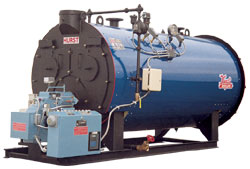

- Two-pass design eliminates refractory baffles between flue gas passes.
- Minimum maintenance with rugged construction for extra-long life.
- Boiler is of the two-pass, scotch type, built and stamped in accordance with the requirements of the ASME Code, and listed by the National Board of Boilers and Pressure Vessel Inspectors.
- Large combustion chamber with low heat release for complete combustion.
- Smoke box is front-mounted with slip-on stack connector.
- Access to fireside is accomplished with hinged and davited rear door. All sizes 40 HP & larger with split front doors. Flame observation ports are on front and rear.
- Openings for cleanout inspection of waterside are provided with 3” x 4” hand holes, and with 12” x 16” manholes (70 HP & larger).
- Insulated with 2” high-density mineralwool, lagged with 22 gauge grip jacketing, baked on epoxy enamel to resist chipping and fading.
- Firetubes are rolled and beaded on power boilers, expanded and flared on low pressure boilers (2” dia. through 30 HP, 2 1/2” dia. 40 HP up).
- Supports include lifting lugs securely welded to the top of shell; structural steel support legs on skids support the boiler so that special foundations are not required.
300 Series Firetube Dryback
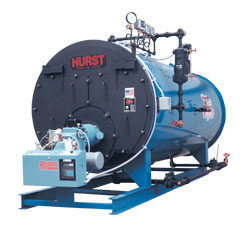
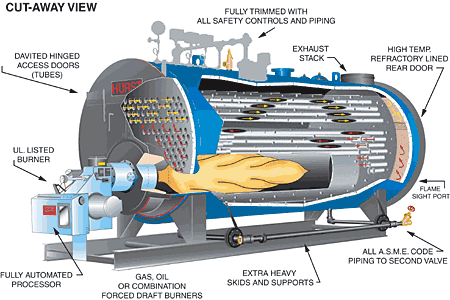
- Three-pass design.
- 81% minimum efficiency.
- Davited rear doors.
- Low maintenance.
- 5 sq. ft. heating surface/HP.
- Durable design.
- Heavily constructed.
- Boiler is of three pass dry back, scotch type, built and stamped in accordance with the requirements of the ASME Code, and listed by the National Board of Boilers and Pressure Vessel Inspectors.
- Large combustion chamber with low heat release for complete combustion.
- Rear smoke box includes slip-on stack connector and features hinged and davited rear door (all sizes) with 16” dia. access door with 2” observation port (80 Hp & larger).
- Front doors are hinged, bolted and insulated (80 Hp & larger) to provide ready access to all firetubes.
- Large 12” x 16” manholes are standard on larger units (40 Hp & up). Cleanout hand holes 3” x 4” are furnished in the bottom of the boiler shell.
- Insulated with 2” high-density fiberglass, the shell is covered with 22 gauge grip jacketing and spray baked on powder coat finish.
- 2 1/2” dia. steel firetubes (2” dia. through 30 Hp) are rolled and beaded on power boilers, expanded and flared on low pressure boilers.
- Twin lifting lugs are securely welded to the top of the shell. Heavy steel support legs on skids provide support for the boiler & burner.
400 Series Firetube Wetback
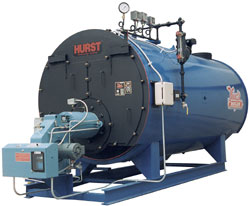

- Three-pass wet back design eliminates refractory baffles between flue gas passes.
- Minimum maintenance with rugged construction for extra-long life.
- U.L. listed boiler/burner package for firing gas, oil and combination gas/oil.
- Factory tested and checked for optimum operating efficiency.
- Built in accordance with the ASME Code, the wet back design has proven to give much longer useful life cycles than dry back boilers.
- Each unit is tested and inspected, and is registered with the National Board of Boiler and Pressure Vessel Inspectors.
- Hurst Boiler utilizes state of the art computer design techniques in every boiler. This accounts for accurate calculations of construction materials and optimum utilization of the boiler’s performance criteria.
- The Series 400 is designed for optimum fuel efficiency and has proven in certified tests to meet and often exceed the efficiencies of 4-pass boilers.
- There is no refractory rear door, to maintain and no refractory baffles to replace. Elimination of these components results in thousands of dollars of savings.
- The wet back has independent tube sheets with uniform temperatures. Three and four pass dry back boilers have tube sheets with large temperature variations and this results in premature tube failure and cracks in the tube sheets.
- Since there is no large refractory rear door, one man can easily remove the rear cover plates for access to the tubes. Front doors can be opened without removing burner components or controls.
- With computer aided design, Hurst has made the wet back a space saving workhorse without sacrificing the principle of 5 sq. ft. of heating surface per BHP.
500 Series Firetube Wetback
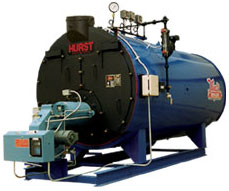

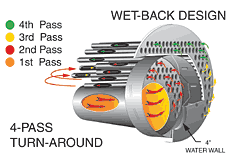
- Four-pass wet back design eliminates refractory baffles between flue gas passes.
- Minimum maintenance with rugged construction for extra-long life.
- U.L. listed packaged burner for firing gas, oil and combination gas/oil.
- Factory tested and checked for optimum operating efficiency.
- Built in accordance with the ASME Code, the wet back design has proven to give much longer useful life cycles than dry back boilers.
- Each unit is tested and inspected, and is registered with the National Board of Boiler and Pressure Vessel Inspectors.
- Hurst Boiler utilizes state of the art computer design techniques in every boiler. This accounts for accurate calculations of construction materials and optimum utilization of the boiler’s performance criteria.
- The Series 500 is designed for optimum fuel efficiency. The introduction of the fourth pass extracts every BTU of spent energy possible that would otherwise be vented to the stack of dry back boilers.
- There is no refractory rear door, to maintain and no refractory baffles to replace. Elimination of these components results in thousands of dollars of savings.
- The wet back has independent tube sheets with uniform temperatures. Three and four pass dry back boilers have tube sheets with large temperature variations and this results in premature tube failure and cracks in the tube sheets.
- Since there is no large refractory rear door, one man can easily remove the rear cover plates for access to the tubes. Front doors can be opened without removing burner components or controls.
- With computer aided design, Hurst has made the wet back a space saving workhorse without sacrificing the principle of 5 sq. ft. of heating surface per BHP.
Due to territory restrictions we can only sell new Hurst boilers inside our Indiana, Illinois, and Kentucky territory.
If you are located elsewhere, you will need to contact the representative in your area for pricing.
Directory of Hurst representatives